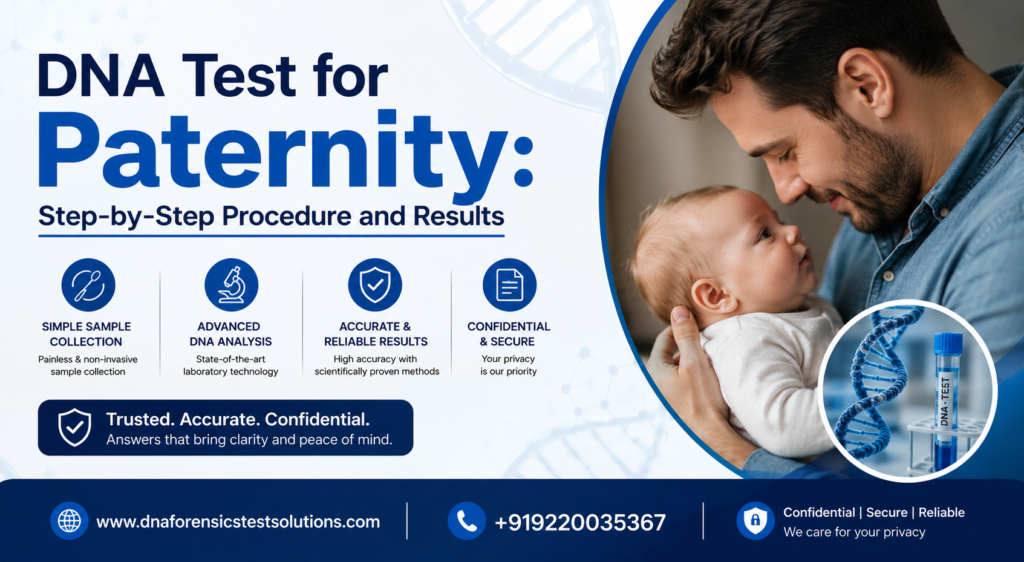
DNA Test for Paternity
If you are trying to confirm a biological relationship between a father and a child, a DNA test is the most accurate and reliable method available today. Whether you need it for legal purposes, peace of mind, or medical history, understanding how the process works helps you prepare confidently.
At DNA Forensics Test Solutions, we provide accurate, confidential, and reliable DNA testing services.
What Is a Paternity DNA Test?
A paternity DNA test compares a child sample against that of an alleged father to determine whether or not human beings share a biological relationship. Specific genetic markers are used by scientists to confirm or rule out paternity with a probability of over 99.9% accuracy.
The test is helpful in various situations — child support cases, some immigration applications, inheritance disputes and personal confirmation. It is non-intrusive, facilitates rapid testing, and boasts a high level of reliability.
Types of DNA Tests for Paternity
Before jumping into the procedure, you should know there are two main types:
1. Legal Paternity DNA Test The sample is collected by a licensed individual and can be used in court. This is necessary for any legal issue such as custody hearings or government paperwork.
2. Home Paternity DNA Test This is the Home Paternity DNA Test which you’ll be ordering online.
Step-by-Step Procedure for a DNA Test
Step 1: Order Your DNA Test Kit or Schedule an Appointment
For a home test, order a kit online. It usually arrives within 2–5 business days and includes:
- Buccal (cheek) swabs
- Sample envelopes
- Consent forms
- Return packaging
For a legal test, schedule an appointment at a collection center, a hospital, or a physician’s office.
Step 2: Collect the DNA Sample
DNA collection for a paternity test is simple and painless. The most common method is a buccal swab — a cotton-tipped swab rubbed on the inside of the cheek for about 30 seconds.
Important tips before collection:
- Do not eat, drink, smoke, or chew gum for at least 30 minutes before swabbing
- Use each swab only once
- Label all samples clearly with the participant’s name and role (child, alleged father, mother)
- Let swabs air dry before sealing them in the envelope
Both the child and the alleged father must provide samples. Including the mother’s DNA is optional but can increase result accuracy.
Step 3: Send the Samples to the Lab
Seal the dried swabs in the provided envelopes and ship them using the return packaging. For legal tests, the collection professional handles this directly. Home test participants mail the samples themselves.
Most labs receive samples within 1–3 business days after mailing.
Step 4: Lab Analysis — How the DNA Is Processed
Once the lab receives your samples, technicians extract DNA from the cheek cells. They then analyze a set of genetic markers called STRs (Short Tandem Repeats). The standard paternity test examines at least 20 STR markers.
Markers that do not match indicate the tested man is not the biological father. Markers that consistently match confirm biological parentage.
Step 5: Receive and Read Your Results
Results are typically ready within 2 to 5 business days after the lab receives the samples.
Results are delivered via a secure online portal, email, or postal mail.
How to Read Paternity DNA Test Results
The result report can look technical at first glance, but it comes down to two key numbers:
Probability of Paternity:
- 99% or higher — The tested man is confirmed as the biological father
The report also shows the Combined Paternity Index (CPI), which is a statistical measure of how strongly the DNA evidence supports paternity. A CPI above 100 generally supports inclusion.
There is no partial result — paternity is either confirmed or excluded based on the genetic evidence.
Factors That Affect DNA Test Accuracy
- Sample quality — Contaminated or degraded swabs can affect the analysis
- Number of markers tested — More markers mean higher confidence
- Lab accreditation — Certified labs follow protocols that prevent errors
- Identical twins — Standard DNA tests cannot distinguish between identical twins since they share the same genetic profile
Is the DNA Test Safe?
Yes. Buccal swab collection carries no health risks whatsoever. Even prenatal non-invasive testing is safe since it only requires a blood draw from the mother. The older methods like amniocentesis carry minor procedural risks, but they are rarely used today for paternity purposes alone.
Conclusion
A DNA test for paternity gives you a clear, science-backed answer about biological relationships. The procedure is simple, non-invasive, and highly accurate. Whether you need results for personal closure or legal proceedings, choosing an accredited lab and following the collection steps carefully ensures you get reliable answers.
If you are unsure which test type suits your situation, consult with a genetic counselor or legal advisor before ordering a kit.
Frequently Asked Questions (FAQs)
Q1. How accurate is a paternity DNA test?
A paternity DNA test delivers over 99.9% accuracy when confirming biological paternity and 100% accuracy when excluding an alleged father. Certified labs use highly sensitive technology that makes errors extremely rare.
Q2. Can you do a DNA test without the father’s knowledge?
Legally, you cannot use someone’s DNA without their consent in most countries. Courts do not accept results obtained without proper consent. Always follow the legal guidelines in your region before collecting any sample.
Q3. How much time does it take to get DNA test results?
Standard results take 3 to 5 business days after the lab receives the samples. Rush processing is available at most labs and can reduce turnaround time to 24 to 48 hours.
Q4. Can a DNA test be done before birth?
Yes. A Non-Invasive Prenatal Paternity (NIPP) test uses a blood sample from the pregnant mother and a cheek swab from the alleged father. You can do this test as early as 7 weeks into the pregnancy.
Q5. What happens if the alleged father refuses to take a DNA test?
In a legal case, a court can order a mandatory DNA test. In a civil matter, refusal may be taken as an indication of paternity by the judge, depending on the jurisdiction. For personal situations, some labs offer alternative relationship testing using other biological relatives.
