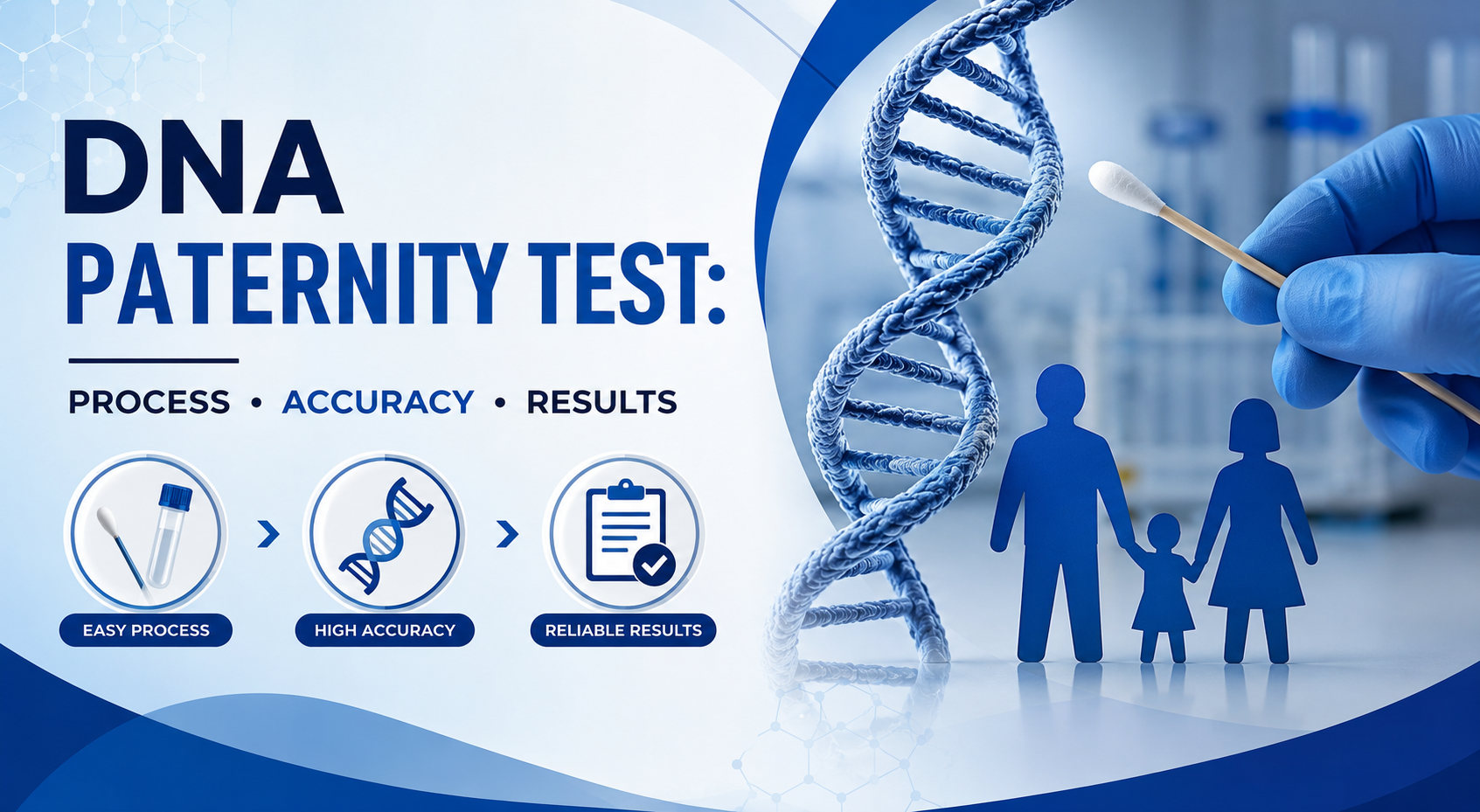
A DNA paternity test compares genetic markers called short tandem repeats (STRs) between a child and an alleged father to determine biological parentage. When paternity is confirmed, results are 99.99% or higher in accuracy; when it’s excluded, the result is 100% conclusive. The right type of test — legal, peace-of-mind, or prenatal — depends entirely on what you plan to do with the result.
What is a DNA paternity test?
A DNA paternity test is a genetic comparison that determines whether a man is the biological father of a child. Every child inherits one copy of each genetic marker from their mother and one from their biological father. Labs compare short tandem repeat (STR) markers — usually 16 to 20+ of them — between the child and the alleged father. If the markers match at nearly every location, paternity is confirmed with near-certainty. If several markers fail to match, paternity is excluded outright.
This isn’t a simple similarity comparison—it’s based on statistical analysis. Labs compute a Combined Paternity Index (CPI) from the matching markers and convert it into a probability of paternity, which is what appears on your final report.
Why people get a paternity test
There are four common reasons people request paternity testing:
- Legal matters — child support, custody, visitation rights, or inheritance claims often require documented proof of paternity.
- Immigration and citizenship — some visa and citizenship applications require proof of a biological parent-child relationship.
- Medical history — knowing the correct biological family tree matters for assessing inherited health risks.
- Personal clarity — many people simply want a definitive answer to move forward, whatever the outcome.
Whatever the reason, the process and science behind the test stay the same — what changes is which type of test you need, which we’ll cover next.
Just How Reliable Is a DNA Paternity Test
This is the question almost everyone searching “DNA paternity test” actually wants answered, so here it is directly: when a man is the biological father, an accredited lab will typically report a probability of paternity of 99.99% or higher. If he is not the biological father, the report shows a complete, unambiguous exclusion — just two or three non-matching markers are enough to rule him out with full certainty.
Several factors determine the reliability of a specific result:
- Number of markers tested — more markers analyzed means a statistically stronger conclusion.
- Lab accreditation — accredited facilities (look for ISO 17025 or equivalent certification) follow validated, peer-reviewed methodology.
- Sample integrity — professionally collected, witnessed samples carry a lower risk of contamination or mix-up than self-collected ones.
In short: the science itself is extremely reliable. Where results can go wrong is almost always in sample handling, not the underlying test.
Legal vs. peace-of-mind vs. prenatal testing — which do you need?
Not every paternity test serves the same purpose, and choosing the wrong one can cost you time later if you need to redo it properly.
Peace-of-mind (non-legal) test samples are self-collected at home, usually with a cheek swab. It’s private, convenient, and gives you a scientifically accurate answer — but because there’s no independent witness confirming who provided the samples, it cannot be used in court, for government paperwork, or for immigration purposes.
Legal / chain-of-custody test A neutral, trained collector verifies photo ID, witnesses the sample collection, and documents a sealed chain of custody from collection to lab. This version is admissible for court proceedings, child support cases, custody matters, and immigration or citizenship applications.
Prenatal paternity test Can be performed during pregnancy either invasively (amniocentesis or CVS, done by a physician) or non-invasively (isolating fetal DNA from a maternal blood draw). This is typically used when legal or medical clarity is needed before the baby is born.
A simple rule to follow: if there’s any possibility the result will ever be used officially — in a court, embassy, or government office — start with the legal version. A peace-of-mind result cannot be converted into a legal one after the fact; you’d have to redo the entire test with proper chain-of-custody documentation.
How the test works, step by step guide
- Sample collection. A cheek (buccal) swab or an EDTA blood draw is taken from both the child and the alleged father. For legal tests, a certified, neutral collector oversees this step and verifies identity.
- Documentation (for legal tests). Photo ID, signed consent forms, and a tamper-evident, sealed sample kit accompany the samples to preserve their legal validity.
- DNA extraction and analysis. The lab extracts DNA from the samples and amplifies the STR markers using capillary electrophoresis, a well-established forensic genetics technique.
- Statistical comparison. The lab compares markers between the child and alleged father and calculates a Combined Paternity Index, which is then converted into a probability of paternity.
- Reporting. You receive a clear report stating either that paternity is “not excluded” (with a probability, typically 99.99%+) or “excluded” (0% match).
Consent is required at every stage — from the adult being tested, or from a child’s legal guardian if a minor is involved.
What affects turnaround time
Most standard paternity tests are processed within a few business days once the lab receives both samples, though the exact timeline depends on a few factors:
- Sample type — cheek swabs are generally quicker to process than blood samples.
- Test complexity — a straightforward two-person comparison is faster than a prenatal, siblingship, or motherless (father-and-child-only, without maternal DNA) test, which require additional statistical modeling.
- Collection logistics — home collection versus in-clinic collection, and how quickly samples reach the lab, both affect the overall timeline.
- Express processing — many labs offer expedited turnaround for time-sensitive legal or medical situations.
For an exact timeline based on your specific situation, it’s best to confirm directly with the lab handling your case, since processing capacity and test type both play a role.
At-home paternity test kits: what they can and can’t do
For those who simply want personal clarity, at-home kits remain a valid and reasonable choice. They’re private, simple to use, and give you scientifically accurate results using the same STR analysis methodology as legal tests.
Where they fall short: because samples are self-collected with no independent witness, the result cannot be used for court proceedings, child support determinations, custody cases, or immigration applications — no matter how accurate the underlying science is.
Common issues with self-collected samples:
- Insufficient cheek cells collected on the swab
- Cross-contamination between the two people’s samples
- Missing signed consent when a minor is involved
If there’s even a small chance you’ll need the result for an official purpose down the line, it’s worth starting with a legal, chain-of-custody test rather than risking having to repeat the process later.
What to prepare before testing
A little preparation makes the process smoother, especially for legal tests:
- Valid government-issued ID for every adult being tested
- Birth certificate of the child, required for legal tests
- Signed consent from the adult being tested, or from the child’s legal guardian
- A clear understanding from your provider of their confidentiality policy and how results will be delivered
- Emotional preparation — a paternity result can be significant for everyone involved, regardless of the outcome, so consider who you’d like present when you receive it
It’s worth noting that peace-of-mind and at-home tests are intended for personal information only, and this should be clearly understood by all parties before samples are collected — they are not a substitute for a legal, chain-of-custody test.
Understanding your results
Your report will state one of two outcomes:
- Paternity not excluded — the alleged father’s markers match the children at nearly every location tested, with a probability of paternity typically reported at 99.99% or higher.
- Paternity excluded — multiple markers fail to match, which conclusively rules out the alleged father as the biological parent, with 100% certainty.
If you’re unsure how to interpret a specific report, a good lab will walk you through exactly what the numbers mean before you leave with more questions than answers.
Frequently Asked Questions (FAQs)
Q1. How Accurate Is a DNA Paternity Test?
When performed at an accredited laboratory, a DNA paternity test provides a probability of paternity of 99.99% or higher when a match is confirmed and 100% exclusion when the alleged father is not the biological parent. The reliability of the result depends on the number of genetic markers analyzed and the quality of sample collection and handling.
Q2. What Do My Results Actually Mean?
Your report will show one of two outcomes: “Not Excluded”, meaning the alleged father is the biological parent with a probability of 99.99% or higher, or “Excluded”, meaning paternity is ruled out. A probability of 99.99%+ is the accepted scientific and legal standard for confirming paternity.
Q3. How Long Does It Take to Receive My Results?
Most standard DNA paternity test results are available within 3–7 business days after the laboratory receives all required samples. Many accredited labs also offer 24–48-hour express processing for urgent legal or medical cases.
Q4. Can an Ancestry DNA Test Be Used to Prove Paternity?
No. Ancestry DNA tests are designed to explore family origins and genetic relationships, not to establish legal paternity. Only a chain-of-custody paternity test conducted by an accredited laboratory is accepted for legal purposes.
Q5. What Determines the Cost of a DNA Paternity Test?
The cost depends on several factors, including whether you need a peace-of-mind or legal test, the number of participants, professional sample collection requirements, and any expedited processing requests.
Q6. Can Paternity Be Tested If the Father Isn’t Available?
Yes. If the alleged father cannot provide a sample, laboratories may compare DNA from close biological relatives, such as grandparents or siblings. While this approach can provide valuable evidence, it is generally less conclusive than direct father-child testing.
Q7. How Quickly Are Results Typically Delivered?
Standard processing usually takes 3–7 business days, while many laboratories offer express testing with results available within 24–48 hours for an additional fee.
Q8. Do I Need DNA Samples From Both the Child and the Alleged Father?
Yes. A direct paternity test requires DNA samples from both the child and the alleged father. Samples are typically collected using a painless cheek swab, allowing the laboratory to make a highly reliable genetic comparison.
Q9. How Early Can a Newborn Be Tested?
A newborn can be tested immediately after birth using a simple cheek swab. The procedure is safe, non-invasive, and suitable for infants of any age. In certain medical situations, other sample types may also be used.
Q10. Can DNA Testing Confirm a Sibling Relationship?
Yes. A siblingship DNA test compares shared genetic markers to determine whether two individuals are biologically related. Although it is not as conclusive as a direct paternity test, it can provide strong supporting evidence when the alleged father is unavailable.